
Exposed Concrete in Houses: Beauty, Technique and the Care that Makes the Difference
Exposed concrete requires well-made formwork, controlled curing and protection. See where to use it in the house and get to know Casa Bloco, an award-winning project executed by EZA.
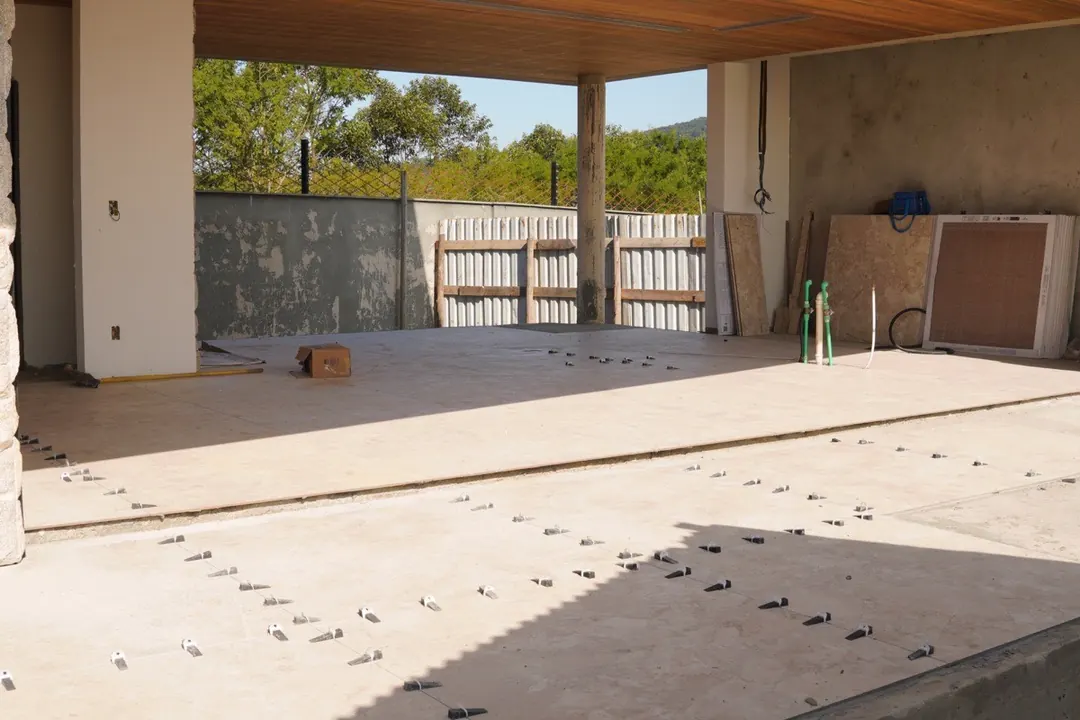
Exposed concrete is concrete left in view as the final finish, with no plaster or paint hiding the surface. The structure becomes the finish itself, and that is where both the beauty and the risk lie: whatever comes out of the formwork is what you will be looking at for the coming decades. After more than 35 years of building in Criciúma, we have learned that exposed concrete in homes does not forgive improvisation, and that it deserves the same rigor as the rest high-end materials of the house. Here we explain why the execution needs to be impeccable, where to use it and the award-winning example of Casa Bloco, a project that EZA built.
What exposed concrete actually is
Exposed concrete is structural concrete that is left exposed as the final finish. No plaster, no skim coat, no paint over it. The wall, the column or the slab comes out of the formwork and stays that way, with the color, texture and marks of the material itself.
This texture comes straight from the formwork. A smooth plastic-coated panel yields an almost polished surface, a wooden board leaves the grain drawn into the concrete, and the tie holes become marked dots on the wall. Used well, this pattern is part of the composition and dialogues with wood, glass and contemporary designs.
Why there is no second chance in construction
On an ordinary wall, the render covers small defects and the paint takes care of the rest. In exposed concrete there is no such correction layer. A honeycomb (a pocket of stones without mortar, a sign of poor compaction), a misaligned formwork joint or a demolding stain remain recorded on the wall forever.
That is why the project has to be thought out backwards. The layout of the formwork, the position of the tie holes and the concrete-pour stopping points are defined in the design, not improvised on site. And on pouring day, correct vibration, placement at the right height and control of the concrete make all the difference. On EZA's projects, the concrete pour is overseen by an engineer to secure these details.
Formwork, curing and protection: the tripod of the result
The formwork is the mold and the mirror of the result. It needs to be watertight so it does not leak cement paste (which causes dark stains), rigid so it does not open under the pressure of the concrete, and treated with the right release agent. Formwork worn out from being reused so many times imprints every defect onto the wall.
Curing is the most shortchanged stage in rushed projects, and it's where many a beautiful wall is lost. The concrete needs to stay moist in the first days so the cement can hydrate completely. Poor curing produces fine cracks and differences in tone that can't be fixed afterward.
And even when perfect, exposed concrete should not be left bare. The surface is porous and absorbs water, soot and grease. A colorless water repellent or a specific varnish protects against staining and against carbonation, which over the years can reach the reinforcement. This protection is renewed from time to time.
Where exposed concrete works best in the house
In our experience, the material works better as a highlight, not as the rule for the whole house. One volume of the facade, the exposed slab of the living area, a stairway wall or the entrance wall already give the character the client is after, without leaving the spaces cold.
From the outside, it shows very well in high-end house facades, marquees, pergolas and walls. Near the beach, the sea air calls for reinforced protection renewed more frequently. Inside the house, exposed concrete slabs with well-resolved lighting are a classic.
- Facade volumes and planes
- Exposed slabs and ceilings in living rooms and verandas
- Feature walls in staircases and halls
Bloco House: award-winning exposed concrete here in Criciúma
Anyone who wants to see well-executed exposed concrete up close doesn't need to leave Criciúma. Casa Bloco, a 247 m² residence in Condomínio Jardins, combines exposed concrete, reclaimed demolition wood and metal roofing in a concept where the roof blocks seem to float. The design is by ES Arquitetura, of architect Diego Justo do Espírito Santo. The execution is ours, EZA Engenharia's.
The result traveled the world. The project won 1st place in the residential category of the UDAD (Urban Design & Architecture Designer Award) in 2019, 3rd place in the 7th Saint-Gobain Architecture Award, was nominated for ArchDaily's Building of the Year 2020 and selected for an exhibition parallel to the Venice Architecture Biennale in 2021. The full story is in the post by Casa Bloco.
For us, the lesson is simple: high-end exposed concrete is born from design and execution moving together. There, every form and every concrete pour was treated as a final finish, because that is exactly what it would be.
Exposed concrete accepts no middle ground: either the execution is impeccable, or the defect stays exposed on the wall. With a detailed design, a trained team and engineering following closely, the result lasts decades and never goes out of style. EZA has built high-end houses in Criciúma and the region since 1991, and Casa Bloco shows what we deliver when it comes to exposed concrete. If you're thinking of using the material in your house, take a look at the projects we have already delivered and reach out to us on WhatsApp (48) 99191-2018 or by email at [email protected]. Let's talk about your project.
Frequently asked questions
Is exposed concrete cheaper because it does away with plaster and paint?
It is not quite like that. You save on the finishing layers, but you spend more on quality formwork, controlled concrete, and specialized labor, because a mistake there cannot be fixed. In the end, the cost stays close to that of a good-standard finish. What changes is where the money is invested.
Does exposed concrete stain or suffer from moisture?
Without protection, yes. The surface is porous, it absorbs water and dirt, and that causes stains and can accelerate carbonation. With a suitable water repellent or varnish, applied after curing and renewed periodically, the wall lasts decades well cared for.
Can I decide to use exposed concrete with the project already underway?
The ideal is to decide while still in the design phase. The layout of the formwork, the concrete pouring points and even the embedded installations change when the structure is going to be left exposed. With the structure already up, what is almost always left is to redo it or to accept a result below expectations.
Want to build your high-end house in Criciúma?
EZA Engenharia takes care of your project from start to handover, since 1991.
Chat on WhatsApp Request a quote